This Is What Ubisoft's New Operating Model Looks Like
Ubisoft's restructuring continues. Going forward, the company will operate under a new, decentralised model structured around five Creative Houses, with an additional group-level structure above them. Many other changes will also be implemented.
Ubisoft's new operating model centres on five specialised Creative Houses to support the company's strategic focus, a refocused games portfolio offering higher quality, and accelerated cost reduction initiatives. Yves Guillemot, Founder and CEO of Ubisoft, said: "On the one hand, the AAA industry has become persistently more selective and competitive with rising development costs and greater challenges in creating brands. On the other hand, exceptional AAA games, when successful, have more financial potential than ever. In this context, today we are announcing a major reset built to create the conditions for a return to sustainable growth over time. We are transforming Ubisoft's operating model to produce exceptional quality games on the two core pillars of our strategy, Open World Adventures and GaaS-native experiences."
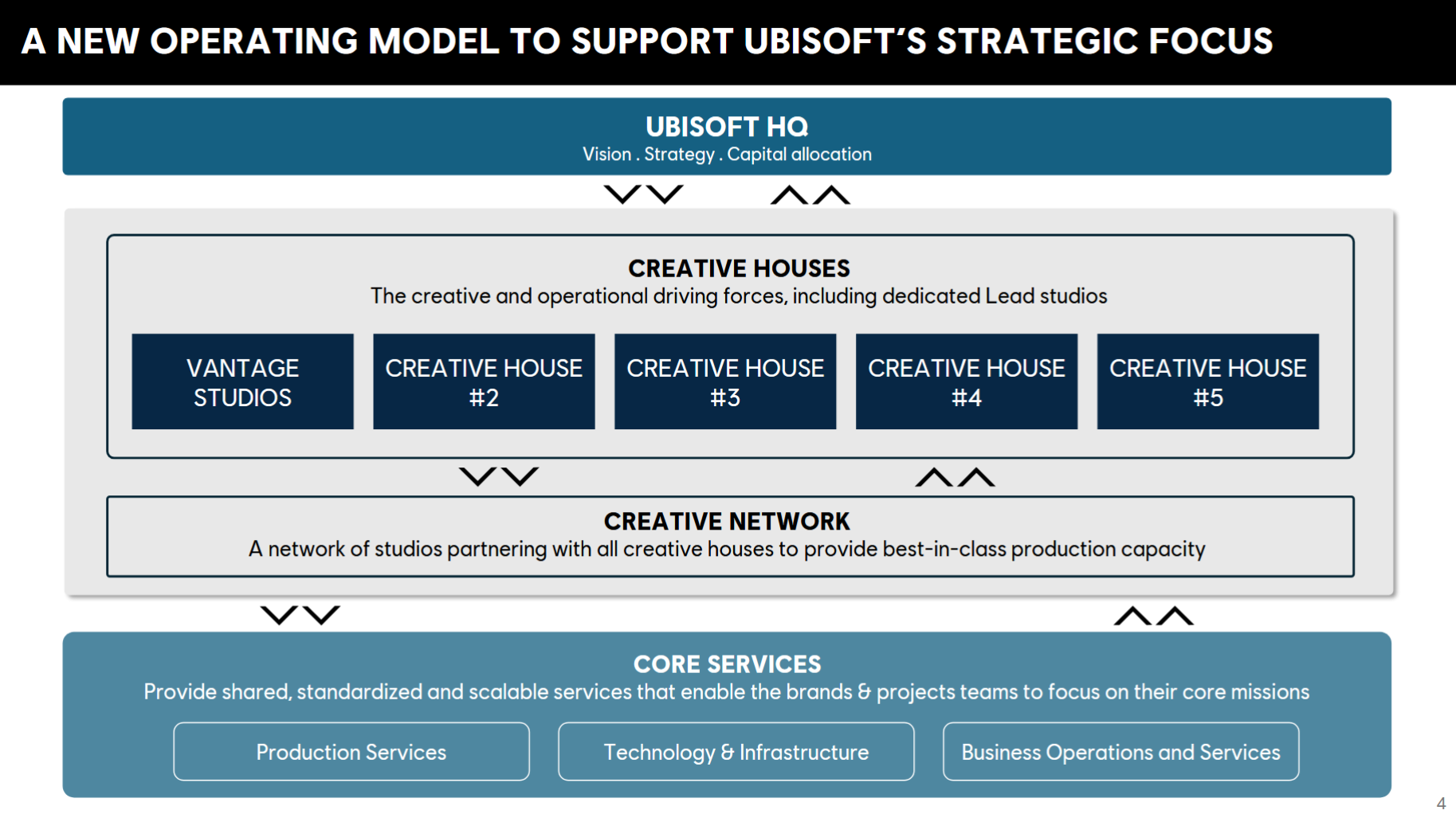
At the heart of this transformation are the Creative Houses: integrated business units that combine production and publishing, thereby unifying the relationship with players. "Each one is built around a clear genre and brand focus, with full responsibility and financial ownership, led by dedicated leadership teams. It is a radical move, relying on a more decentralized creative organization with faster decision making and best-in-class cross functional core services supporting and serving each Creative House," the CEO said.
The five Creative Houses will be supported by a Creative Network, which will provide development resources and shared core services, as well as a reshaped HQ. The new organisation will begin operating in early April 2026.
The Creative Houses
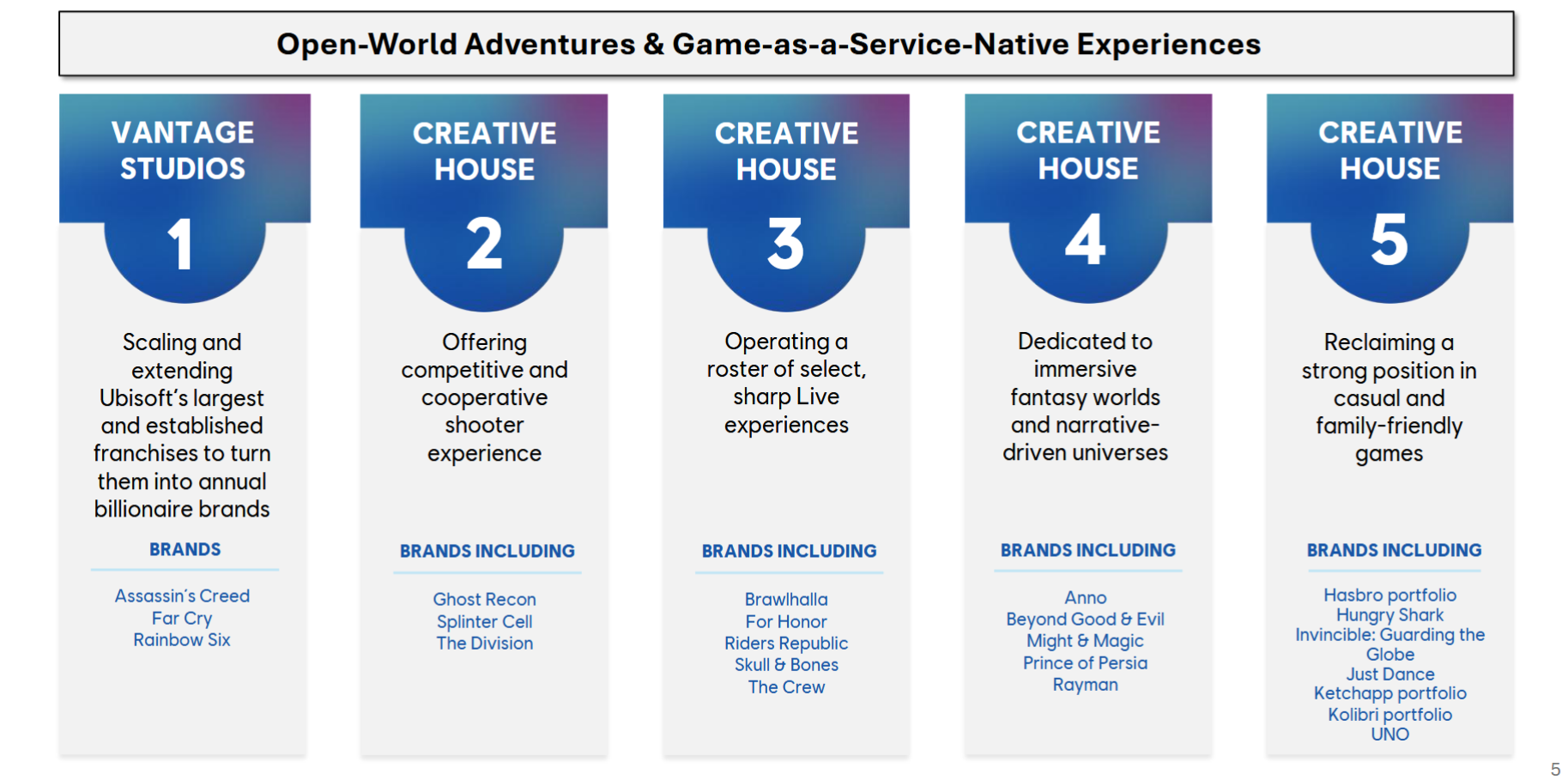
The five Creative Houses are integrated business units that have undergone three major changes. Firstly, they will combine game development and go-to-market functions, adopting a gamer-centric approach. They will take full responsibility for brand development and content strategy. Secondly, they will be shaped by distinct creative 'genres', led by dedicated teams with expertise in those genres. Thirdly, they will have full financial ownership and be accountable for economic performance. However, the new operating model will not change the fundamental strategy of the publisher, which is based on Open World Adventures (1) and GaaS-Native Experiences (2).
Creative House 1 comprises the Vantage Studios, which are focused on scaling and extending Ubisoft's biggest franchises, such as Assassin’s Creed, Far Cry and Rainbow Six, in order to turn them into annual billion-dollar brands.
Creative House 2 is dedicated to competitive and cooperative shooter experiences. Brands include The Division, Ghost Recon and Splinter Cell.
Creative House 3 is designed to operate a select roster of live experiences. Brands include For Honor, The Crew, Riders Republic, Brawlhalla and Skull & Bones.
Creative House 4 is dedicated to immersive fantasy worlds and narrative-driven universes. Brands include Anno, Might & Magic, Rayman, Prince of Persia and Beyond Good & Evil.
Creative House 5 is focused on reclaiming its position in the casual and family-friendly gaming market. Brands include Just Dance, Idle Miner Tycoon, Ketchapp, Hungry Shark, Invincible: Guarding the Globe, Uno and Hasbro.
Additionally, there are currently four new IPs in development, including March of Giants. Ubisoft will announce their respective creative homes at a later stage.
Ubisoft also aims to strengthen workplace presence. "To support the effective implementation and operation of this new model, the Group also intends to return to five days per week on site for all teams, complemented by an annual allowance of working-from-home days. This evolution is intended to strengthen collaboration, including constant knowledge sharing, and the collective dynamic across teams. In-person collaboration is a key enabler of collective efficiency, creativity and success in a persistently more selective AAA market."
The Group Level
The Group will establish a streamlined organisation designed to support all the Creative Houses while preserving scale benefits and reducing complexity. The new operating model will be underpinned by a reshaped HQ, which will be subject to prior information or consultation with employee representatives where applicable. The headquarters will set the group's strategic priorities, ensure support for all creative houses, and maintain a forward-looking view on industry trends, including technological developments and market innovations. Notably, it will oversee the Group’s talent management and corporate communication strategies, as well as its legal services, capital allocation framework and financing. This should help to align long-term strategy, financial performance and value creation.
As part of its restructuring, Ubisoft has announced that six games that did not meet internal expectations will be cancelled, including the remake of Prince of Persia: The Sands of Time. In addition, seven projects have been postponed and there will also be cuts at the studios (read more).
Impact on the Financial Years
As part of its transformation, Ubisoft has made a number of decisions that will impact the Group's release schedule and portfolio composition. Consequently, the Group no longer considers its previously communicated FY2026-27 guidance to be an appropriate reference, and will therefore update it in May 2026.
For FY2025-26, Ubisoft now expects net bookings of around €1.5 billion, which equates to a gross margin reduction of around -€330 million versus the previous guidance. This mainly reflects changes to the release pipeline for the current FY26 quarter and the decision to postpone negotiations on certain partnerships in the context of the Group's new operating model.
Non-IFRS EBIT is expected to be around -€1 billion, mainly reflecting the impact of the updated FY26 net bookings assumptions described above, as well as the following transformation-related decisions, which have led to a one-off accelerated depreciation of around €650 million through the discontinuation of six games and the allocation of additional time to seven titles. "Non-IFRS net debt of between €150m and €250m as of year-end FY26, with a cash and cash equivalents position of between €1.25bn and €1.35bn vs. prior guidance of around €1.5bn."
Ahead of publishing its Q3 FY2025-26 net bookings on 12 February 2026, Ubisoft is providing an indicative figure of around €330m, primarily driven by overperformance linked to partnerships and reflecting a robust back catalogue. The quarter notably saw the release of Anno 117: Pax Romana and the Avatar: Frontiers of Pandora From the Ashes expansion.
GamesMarkt Daily Newsletter
Sign up to receive the free daily newsletter about the Games Industry in GSA, Europe and beyond.
Marcel Kleffmann is Chief of Content of GamesMarket and our B2B and B2C expert for hardware, market data, products and launch numbers with more than two decades of editorial experience.