Tower Dominion

– 3 min read

The tower defence subgenre of strategy games remains popular, as demonstrated by Kingdom Rush, Emberward and, most recently, Nordhold. Now, Tower Dominion is attempting to bring a touch of roguelike and Fieldrunners flair to the genre.
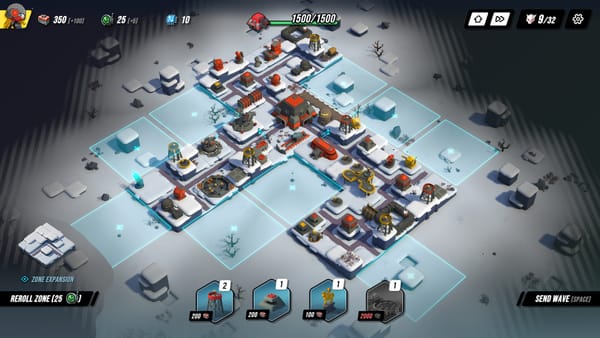
Tower Dominion combines roguelike and tower defense. Players take on the role of a commander who must defend their empire against Artronid invasions. It's all about protecting the HQ against waves of enemies using strategically placed towers that can be upgraded and combined to create synergies. While this may seem familiar, the game emphasises battlefield customisation, as players determine where the enemies will come from.
Every two waves, players must place a new terrain tile on the map, which can feature pathways, natural obstacles, or enemy entry points. These tiles are randomly selected, but players can reroll them by spending Recon, a limited strategic resource. Ideally, the tiles should be placed so that the number of possible entry points is reduced and the enemy troops' paths are lengthened or merged - creating chokepoints, traps or long paths for the enemy is important. However, there is a fairly high random factor because the tiles are drawn. Although it is possible to see which enemy types will appear before the waves, the game does not indicate how many enemies will emerge from each entrance. The game could be more transparent in this regard, which would be particularly helpful when dealing with air units. It simply states that the enemies will be divided 'equally'.
Before each run, players choose a faction. Each faction offers a distinct playstyle, specialised units and a different biome. They then select a commander whose abilities will also influence the overall strategy. There are ten commanders in each faction. Most are locked at first but can be unlocked. The same applies to the five difficulty levels - beginning with 25 waves at level 1 and depending on the difficulty level, the games then become longer (up to endless), with elite enemies with unique traits attacking every five to ten waves. The aim is to place towers of different strengths next to the pathways. The height of the terrain also affects the range of the towers, which is presented visually and intuitively. Mazes that influence the pathways cannot be built; instead, there are the aforementioned placeable tiles. After each wave, players can choose from several unique reward bundles, each containing a mix of doctrines, resources and buildings. However, there is again a fairly high element of randomness here.
As progress is made, players unlock commanders and building upgrades that increase damage, range or fire rate, as well as doctrines that provide bonuses to adjacent buildings or supply production. However, there is no classic meta-progression in the sense of permanent, cross-game upgrades, as found in other roguelike titles. Instead, the progression system focuses on unlocking new commanders, towers and upgrades during runs, which are then available for future playthroughs. A meta-progression system would have enhanced this principle and could also have compensated for the random factor. Additionally, the game could be more transparent about values such as the exact damage that the towers do, and which units they should prioritise attacking. Nordhold does this better, for example.
Tower Dominion was developed by two independent development studios based in Montreal, Canada: Broken Spear (founded in 2019) and Nvizzio Créations (founded in 2015). Parallel 45 Games is a publishing label created specifically for the release of Tower Dominion.
Tower Dominion was released for PC on 8 May 2025. No other ports have been announced yet.
Tower of Dominion successfully combines roguelike and tower defense elements, offering high replay value. However, the random factor is slightly too high, and the game could provide more transparency regarding enemies and stats.