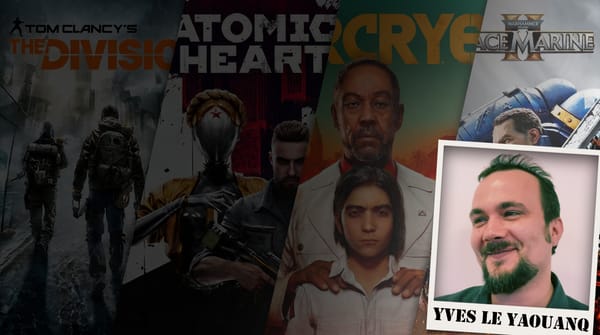
In his latest ‘Zoran's Update’, Zoran Roso tries out a different format: instead of commenting on current developments himself, the industry expert interviews Yves Le Yaouanq, Chief Content Officer Focus Entertainment. GamesMarkt is republishing the update with Zoran's consent.
Are players finally trading the "all-you-can-eat buffet" of AAA live services for the "gourmet menu" of Triple-I gaming? In this interview, Yves Le Yaouanq (CCO, Focus Entertainment) breaks down why distinct identity now beats massive scale and how he spots the "spark" in risky prototypes.
Beyond the hits, Yves offers a critical look at the industry's future leading up to 2026. We discuss his "Federation" strategy for balancing portfolios and his genuine concern that Generative AI might erase the essential training grounds for the next generation of creators.
Zoran Roso: Hi and welcome Yves, thank you for taking the time for this interview! You are able to look back at a tremendously successful and interesting career in the gaming industry and in order to get us going let’s have a look at your early days. You started your career over 25 years ago working on MUDs (Multi-User Dungeons) and early MMORPGs. Looking back at those text-based and early graphical communities, what is the one lesson about "player retention" or "community management" you learned then that still applies to modern blockbusters today?
Yves Le Yaouanq: Part of what would become Community Management, that now exists in all industries, was born there, in videogames, within MUDs and MMOs. At the time, it was a mind shift : less self-centered (as a studio, company, project), with just the studio’s message delivered to an audience, but more collaborative in the communication approach : be transparent, be open, exchange, take into account the feedback, iterate, onboard your players in your development journey, etc.
So it also changed the way to develop and produce these types of games, at the time, by taking into account the time to iterate based on feedback. Plus, the live mindset : not just launching a game, and moving on, but to keep on developing, and make players at home, their home, with regular new content, and hence, constant communication and support. Something, now, that is widespread in our industry.
You spent over 11 years at Ubisoft, transitioning from online strategy to Open Innovation. What was the biggest culture shock moving from a massive global corporation to your current role at Focus Entertainment in 2021?
Yves Le Yaouanq: Ubisoft is, at the same time, yes, a corporation, but also a cluster of different families inside a bigger one, which also allowed exchanges and internal growth and learning. So, not so monolithic big corp in the end.
But the culture shock, at least for me, is not really about size, in the end, and more about dynamic and adjusting/evolving to the new landscape, audience, and context of the world and our industry. That’s more where the difference lies : it’s easier to adapt, adjust and accompany, or even anticipate the change and movement, when you’re more agile and smaller.
Adjusting to a Changed Market
Focus Entertainment has carved out a very specific niche, often referred to as "Triple-I" or high-end AA. How do you personally define that space in the current market, and why do you think it’s becoming so vital as AAA budgets balloon to unsustainable levels?
Yves Le Yaouanq: As an industry, we’re not detached from the existing world, outside, and hence, that’s why having a good vision and understanding about the global context is important. How some geopolitical conflicts, currencies changes, political shifts, technological evolutions, might affect prices, purchasing power, even the type of games players will want to play, depending on how safe or worried they are.
At the moment, we’re seeing combined different moves, where, first, the videogame market is much more clusterized, than the global, western-dominated, market we were used to, with new talents, new cultural references, and new creators, are becoming more trending.
And new generations too, with both different approaches to the way we work (creating needs for adjustment on the work conditions), new priorities, different ways of spending their videogame money (more diversified experiences, than one big AAA game that everyone on the planet will play, even if GTA and some others are still there). That’s where III or AA, ie. experience that has an identity, uniqueness, but doesn’t suppose players to have unlimited purchase powers nor unlimited time, can and are shining.
Being French, I often have cuisine and food comparison: we used to be in a buffet situation, where the same crowd had access to a non-stop refill à volonté buffet, and now, players are looking for more meaning and purpose, be it from the local home-made small family restaurant, to a bit more pricy gourmet tailored set menu (ie. not 2000 hours of gameplay).
Players are more mature in their media consumption, making more active, conscious choices rather than passively consuming what is delivered. They are looking for memorable, high-quality experiences, even if they are shorter, rather than endless feasts.
You’ve previously discussed the "WWW" (What, When, Who) of pitching. For a studio approaching you in late 2025/2026, has the "When" changed? Are you looking for vertical slices earlier, or are you preferring paper pitches to shape the project together from the ground up?
Yves Le Yaouanq: It truly depends on the context. For studios with whom we have established trust and validated collaboration, we can greenlight at the pitch deck stage, as both the studio and publisher already know how to work effectively together. For new collaborations, we need reassurance that they can deliver on the exciting pitch, and their approach to prioritization is a key indicator. The required format also depends on the game's genre: if a game is heavily systemic, we need to experience the core systems, even if the build is an ugly prototype or greybox.
However, if the game's promise rests on world-building, art, atmosphere, or narrative, then we generally require a vertical slice. There are exceptions, of course, for brilliant and mature studios who might deliver a functional but rough prototype alongside a non-functional but beautiful 'corner' of the world, which we can then merge in our imagination.
It’s (AI) a complex topic and a tool, so as with every tool, it depends how you use it and plan to use it. AI is already, for many many years, part of the development process. The concern here is about generative AI and relationships with creators, artists, from Art, Concept, 2D, 3D, writing, and even voice acting.
You have a reputation for identifying unique projects (like Disco Elysium or Chants of Sennaar) that don't fit a standard mold. When you look at a weird, risky prototype, what is the specific "spark" or KPI that makes you say, "Yes, we can sell this"?
Yves Le Yaouanq: Mainly three things: a strong identity of the vision and its coherence, the capability of this specific team to deliver it, and how unique it can be within our dynamic market, where genres can wither, or on the contrary, explode.
By identity and uniqueness, I mean both Art, sound, music, narrative, world building, of course, but also, as in order to create, you do it on the shoulders of past giants, as said, how the team understood and digested their references, mastered them, so that they can innovate on solid basis.
As someone sitting in the C-suite of Content, how early do you involve the marketing teams in the greenlight process? Do you ever kill a great game concept because the marketing hook just isn't clear enough for today's noisy social landscape?
Yves Le Yaouanq: Our Marketing team is involved as early as greenlighting in the projects. I, and frankly no one, possess the absolute truth and wisdom on everything, so involving marketing, as well as production, design, business, finance and tech, can help us on some missing angles or risks, or opportunities we didn’t see while presenting the project.
This approach ensures that every team is fully invested and excited about the project, as their expertise is valued from the beginning. Furthermore, it guarantees that all angles are anticipated, setting up a smoother development and go-to-market process.
By 2026, AI integration in development will be standard. From a publisher's perspective, are you worried about a flood of low-quality content, or are you excited about smaller teams finally being able to build massive worlds that used to require 500 people?
Yves Le Yaouanq: It’s a complex topic and a tool, so as with every tool, it depends how you use it and plan to use it. AI is already, for many many years, part of the development process. The concern here is about generative AI and relationships with creators, artists, from Art, Concept, 2D, 3D, writing, and even voice acting.
We’re already seeing some usages that are more on the indie side of dev: an artist creates a few drawings of several weapons or in-game items, an AI generates models and shapes, and an artist validates and finalizes each asset. This is clever, and can save a lot of time and money for a smaller studio. Or using concept arts very early just to showcase a vision and reference, and then have proper concept artists once you’ve chosen the right direction. So it is not about replacing artists, but focusing their talent and expertise on the creative parts.
But the issue or concern with this, is more about the future and next generations : very often, in our industry, these less creative and sometimes repetitive tasks are used as entry level jobs, for new generations to train, improve, learn from leads, etc. What will happen if there is no such entry level job anymore ? Will we become an industry of old people? Who will bring the new references, new tools, new tech, new voices, if we don’t have the room and training for younger creative talents, as their tasks are replaced?
And if we fail to welcome new talents, how quickly will the massive worlds enabled by AI become creatively outdated? It’s a very complex subject, and while there is no easy answer, we cannot ignore its potential alongside the very real concerns expressed by artists and creators.
Discoverability is the #1 threat to our industry. As we look toward 2026, do you think the traditional "Publisher" model will shift more towards being a "Curator/Influencer," or will technical distribution (Cloud, Subscriptions) be the main driver of success?
Yves Le Yaouanq: There is a chain of discoverability that ends up, with the final say, on the platforms, so, the first discoverability challenge probably lies there.
However, a Publisher's role is fundamentally an expertise. Unless every studio and developer can or wants to develop this mastery internally—a process that requires significant time and funding—I don't foresee the publisher model disappearing entirely. It can and will evolve and in many ways already has, moving from a main retail distribution expertise to a digital one, reaching stores, audiences, countries, currencies, that often developers can’t or won’t.
But there is also, in my opinion, much less real concern about discoverability. I totally agree with the findings from Chris Zukowski and Simon Carless, who analyzed the explosion in the number of games on Steam (Discoverability issue and how we’re drowning and competing with 20k other games), and found out that in the end, if you remove the hobbyists, the videogame school training games put on Steam, etc., the number of games with commercial intent, hasn’t increased that much in the end. It’s more that players are more mature and more demanding on the quality and uniqueness of games.
The Industry is more clusterized
We see a swing back and forth between Live Service fatigue and a hunger for single-player narrative (like A Plague Tale). Where do you place your bets for 2026? Will players want 100-hour services or 15-hour polished experiences?
Yves Le Yaouanq: As mentioned, we’re more a clusterized industry, so there are many different audiences, way less unified, with the same habits and needs, than before.You have the Roblox, Minecraft audiences, with the question of, especially for the younger ones, will they move to the more classic environment (Steam, consoles, etc.) ?There are already some positive, and interesting signs, with games coming from, or close to, the Roblox experiences, succeeding on Steam.
Then you have the single-game players, who only play CoD or Battlefield and never have and never will buy anything else, and that’s fine. That’s where pouring gazillions to try to replace a 20+ years old franchise, takes huge risks, huge money, with no certainty of success.
And the core of the videogame players, the ones for whom games is part of their lives, habits, culture, and who might jump from A Plague Tale to Void Crew Coop Multiplayer, or Boltgun direct fun, because on a Tuesday, after a hard day of work or study, you might just want to loosen up and have quick fun on Boltgun, then on Wednesday chill and explore a story and world, and on the week end, play with your friends in space on VoidCrew.
So, I don’t see one big answer that will cater to all. Except GTA probably, which is a 28 years old franchise, built up carefully, that probably will take a lot of time and space in 2026. But since I started 28 years ago in the industry (not on GTA though), I’ve heard “PC is dead”, “Single player is dead”, “Narrative is dead”, etc. so many times. And there has been Steam, Disco Elysium, Baldur’s Gate, and many counter examples that proved the doom predictions wrong every time. When the “glowing future” of certain tech or tools, proved wrong at the same time.
I believe and trust in the audience’s maturing tastes and diversification, and I believe escapism can take many forms, from single player to social or competitive multiplayer, and I don’t see any of the two disappearing.
We rightly discuss how the industry can support cultural diversity, underrepresented genres, and gender diversity. However, because this is an industry reliant on financial bets, we need creators who are not solely dependent on funding from platforms, publishers, or Venture Capital.
You've worked on both sides of the bridge (building bridges with external devs at Ubisoft, and acquiring studios at Focus). Do you think the trend of massive industry consolidation will slow down by 2026, leading to a new renaissance of independent studios, or is the "super-publisher" model inevitable?
Yves Le Yaouanq: One of the big challenges, very often overlooked, to provide sustainability for studios and devs, especially indies, is about social diversity. We rightly discuss how the industry can support cultural diversity, underrepresented genres, and gender diversity. However, because this is an industry reliant on financial bets, we need creators who are not solely dependent on funding from platforms, publishers, or Venture Capital.
If all devs and studios were to originate from more wealthy backgrounds, then that definitely would help survive any crisis or temporary changes. But that is not the reality, so what about creators from different social backgrounds, who have different stories, different gameplays, to tell? That’s the main risk of the uncertainty of the game economy : losing talents that don’t have the sustainability option.
So we need to find diverse models, diverse funding sources, and speaking from France, while it’s not 100% paradise, having grants, funding, and support from different parts (city, region, tax return to fund new projects, etc.), is definitely part of the solution, to answer the question of sustainability.
As for consolidation, if it’s piling up, we’ve seen how dangerous it can be, when you create a bubble. But, like for energy : relying on fuel fossil only is risky, while creating energy mix, with different sources, Publishers, Platforms, VCs, tax incentives, governments, institutions, crowdfunding, banking, is the probable better way to not depend on one source only, and in the end, give back more powers to studios and creators, because they will have options.
If you could put one game from the last 5 years into a time capsule to show developers in 2050 "This is what we achieved," which one would it be and why?
Yves Le Yaouanq: Not a single game, but rather a snapshot of the teams, both developer and publisher. I would show the people who achieved it, together. Collaboration and trust are key, and when the understanding and relationship are truly strong, that is how you achieve great things.
About and contact to Zoran Roso
Zoran Roso stands as a highly influential veteran of the video game and entertainment industry, with a distinguished career spanning over 25 years in global publishing, marketing, and leadership roles. His professional journey includes serving in significant executive positions at some of the world's most recognizable gaming giants, including Rockstar Games/Take 2 Interactive, Activision Blizzard, and Sony PlayStation, where he was instrumental in the marketing and strategic positioning of flagship AAA franchises and brands. Most recently, he leveraged this extensive experience as the Global Publishing & Marketing Director at Tencent Games, a critical role focused on expanding the company's international reach and developing successful go-to-market strategies for its massive portfolio of internal and partner studios.
Now operating as the founder of ZR Consulting, Zoran continues to drive success in the industry by advising major global publishers and developers. His firm specializes in crafting winning strategies for international brand development, optimizing live service performance, and executing flawless launch plans across all major platforms, including console, PC, and mobile. An active figure in the global games community, his career is marked by a clear strategic vision and a successful track record in translating complex products into global commercial successes.
Zoran Roso, founder of ZR Consulting, brings 25+ years of global gaming marketing experience. Formerly Global Publishing/Marketing Director at Tencent Games, he has held leadership roles at Sony PlayStation, Activision Blizzard, and Rockstar Games.